In the district I teach in, we have some required topics and vocabulary. This doesn’t always mix easily with the world of CI. I have found, through my work with Tina Hargaden, that it is possible to integrate required lessons/topics/vocabulary and still make lessons based in communication.
So, how do I do that? Well, one thing I do is follow the curricular framework presented in Tina’s book, Foundations. There are six cycles of instruction, and those really help me frame every lesson and keep a structure, yet still have flexibiity.
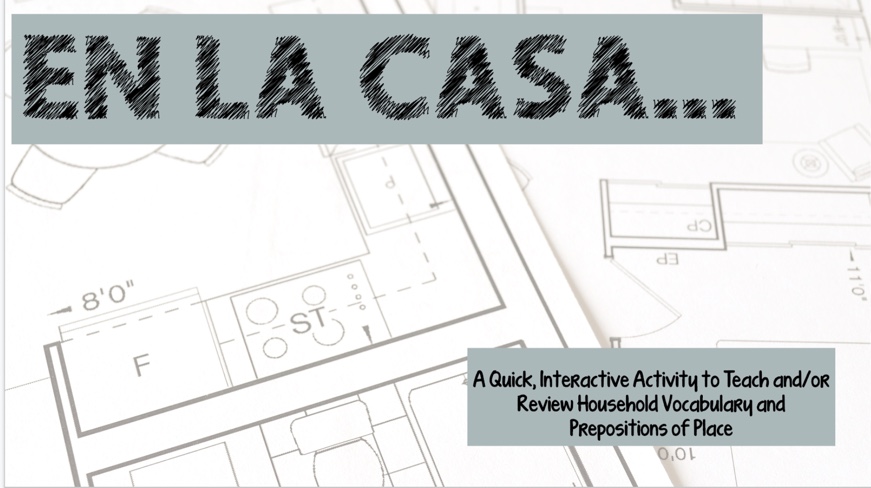
Recently, I had to teach house vocabulary. After introducing the vocabularyThis, I created THIS activity for us to do together. I incorporated a section for us to do together, a listening activity and then an interpersonal communication opportunity for students where they practice listening and speaking with a partner or group. This could also be done virtually by having students submit a video of them talking through their “casa.”
HERE is a Loom video I recorded explaining how I used this resource. Although it is in Spanish, you can absolutely put text boxes over the words (there are only a few) in your language.
I hope this helps with some ideas for teaching these required vocabulary sets and/or topics while keeping lessons focused on communication!
Happy Teaching!
Alana
Find me on Instagram (@SraKSpanish) and Follow my TpT store as I build more resources!
I am gearing up for the first few days back from break! I know, I should be relaxing and disconnecting. I have been, I promise, but I also know I relax better when I am prepared.
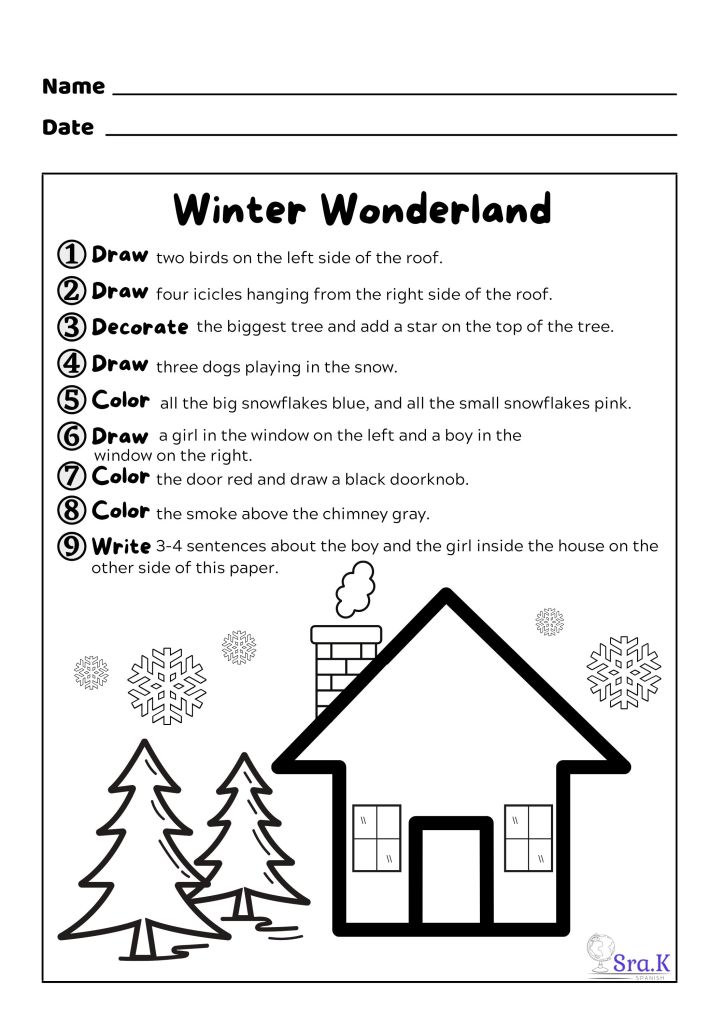
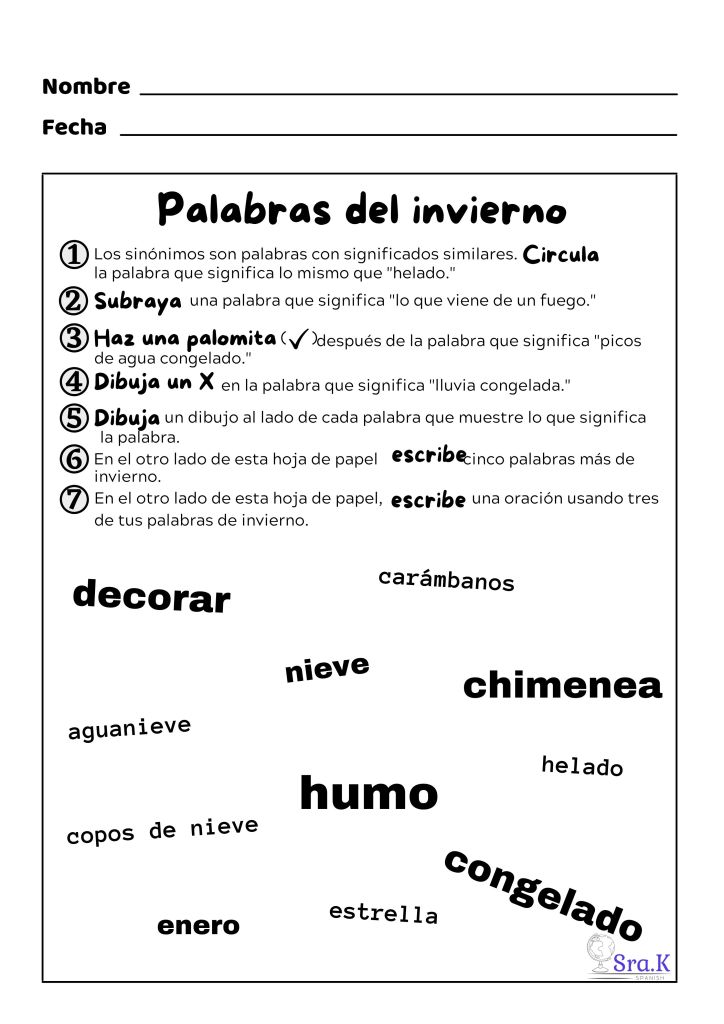
So… I have been continuing with my series of Following Simple Directions worksheets. I know worksheets are NOT the preferred task, and I plan to do a lot of guided vocabulary work and story telling along with this, but, that being said, I feel like my students are better on task when there is something concrete for them to accomplish and turn in. I hope to NOT have to do this next year, but my students seem to really need the structure and to be reminded how to be in school this year.
HERE is the link to the PDF with English AND Spanish
Anyway, I hope you can find some way to use this that will benefit your students. This is just one level. The leveled versions will be up for sale on my TpT store by the end of the week.
HERE is the link to the PDF with English AND Spanish
I have also created some New Year Student Practice for Following Simple Directions for sale on my TpT store. HERE is the link to the Spanish, and HERE is the link to the English.
Happy teaching!
Follow this blog for more great, free resources! Find me on Instagram (@SraKSpanish) and Follow my TpT store as I build more resources!
I am beginning to prep for the next semester and using this time off to create some fun, fresh new resources with that “old school” kind of feel to them. Sometimes, the quick, easy things really help keep class moving.
After talking about houses, looking at pictures of different rooms inside the house (there will be more resources you can find on my TpT store in January), I would give students this page. We could do it together OR they could work with a partner or in small groups OR students could try it on their own. Then, I would have students use this as an example and then have them draw their dream house on the other side of the paper, labeling the rooms and, depending on their level, putting things in the room to support the room.
This is only one level. I do plan to have at least one more level and a digital version with moveable parts in a pack on my TpT store, but I wanted to share THIS free English and Spanish version in hopes it helps you build a lesson that fits well in your teaching context.
I am starting to think about coming back from the break… I know, I know. It creates a little anxiety. What I am feeling this year is that I need to be a little easier on my students AND myself. So, in doing some healthy self-reflection, I have realized what that looks like for me, personally.
Going easy on my students AND myself is remembering that not every activity, every practice has to be catchy and new and fancy. Maybe, just maybe, we need a little bit of the good old days…
In that spirit, I created THIS activity in English AND Spanish. It is part of a bigger pack of a “Following Simple Directions” group of activities. The first part of the series, this Snowman activity, is already up on my TpT store in Beginner, Intermediate AND Advanced versions. Follow the blog to get updates about the rest of the series of activities.
You can find the PDF version in the paragraph above this in the link.
In the product on TpT, there will be another level up to make it more challenging and focused on using commands for upper levels, but I hope this might be an easy, short activity to get everyone all back in the groove when we all have that hard return to classes.
Hope this is, at least, a fun thing to keep in your back pocket for a simple activity that can be printed or put up on your digital classroom.
Follow this blog for more great, free resources! Find me on Instagram (@SraKSpanish) and Follow my TpT store as I build more resources!
Whether you are trying to plan these last few days before winter break or you are trying to find something to plan for the first few days you get back, this may be an easy option!
First, you will have to decide if your students can work in small groups or with a partner, or if that is too much for them this time of year. Personally, my students are at that point where trying to keep them quiet is worse for me than just finding an activity they can do together.
Next, you will need to find enough pieces of poster board, butcher paper, or chart paper so that each group can have one.
Then, give them the instructions:
(This is one I have used in emergency situations for a few years)
Then, make sure you give them a time limit for research. Some students could spend DAYS on the computer getting distracted. I have found that if I give them a very structured schedule of WHEN I expect each part to be done (also known as “chunking the assignment”), then I keep order a lot better during this cultural exploration. For my classes, I only give one day for research if they are working with a partner and one and a half class periods if working alone.
Next, I give them a piece of manila construction paper (smaller pieces of butcher paper or even copy paper would do too). On this, I make them sketch out where they will be putting each piece of information. I remind them to leave room for the title to be the biggest thing at the top or in the middle of the poster. We talk about how the graph and Venn Diagram will take up more space than other things AND that decorations make any poster more appealing.
Finally, I give them the poster and give them another deadline to have it complete. Usually, I give two class periods. They have done the research and made a plan at this point, so it should just be putting the information on the poster and decorating as needed.
Finally, it is time for the Gallery Walk! We hang the posters around the room or down a hallway in the school, whichever works best for your teaching context. Depending on how many posters we have, I give each student a piece of paper and have them fold it into sections (they can write on the front and back of the paper). They will walk around and read about other countries. I usually have them write down the name of the country, the most interesting fact they learned and one thing they noticed that country has in common with our country’s practices (getting in that “Connections” part).
This will generally fill up an entire 5 days of 45-50 minute classes or 2-3 blocks. It is a great strategy for students to research and share information without getting bored through a TON of presentations. You can use this any time of year and for ANY topic you want. You can shorten the project by reducing the number of things they have to find and include on the poster. You can level up or down by choosing the language the posters are created in and the type of information you require.
Hope this helps you plan out an easy week where students learn a LOT about culture and YOU get to just watch them learn and share.
Happy Teaching!
You can go HERE and learn more about the SraKSpanish squads! Join today!
Follow this blog for more great, free resources! Find me on Instagram (@SraKSpanish) and Follow my TpT store as I build more resources!
As we count down to the Winter Break, these students are getting ANTSY and teachers are getting TIRED! So, I created THIS short story activity. The example is in English, but you could use this for ANY language.
There are LOTS of possibilities with this assignment. I created a Spanish version and a Beginner Version of both English and Spanish already done for you in my TpT store, but you can totally do this on your own.
For beginners: Give them sentences already written and have them put them in order. OR, have them describe the people and places by listing words and labeling the things in the pictures.
For intermediates: You can scaffold by giving them some sentence starters or a word bank and having them write sentences for each box. You could also have them do the beginner activity and then level up by having them add more sentences to the story.
For advanced students: You can have them do all of the above. You could have them describe the boxes one by one to a classmate and have the classmate draw what they hear. You could have them complete the above as a mentor text and then have them create a story of their own using the example.
So many variations! I hope this might help at least keep your students engaged and working for at least one class period!
Don’t forget to follow the blog to get more freebies and activity ideas!
Happy Teaching!
Follow this blog for more great, free resources! Find me on Instagram (@SraKSpanish) and Follow my TpT store as I build more resources!
So, I use the Stepping Stones Curricular Framework from CI Liftoff to guide my instruction, BUUUUTTTTT I also work in a district with a required curriculum too! So, how do I make that work?
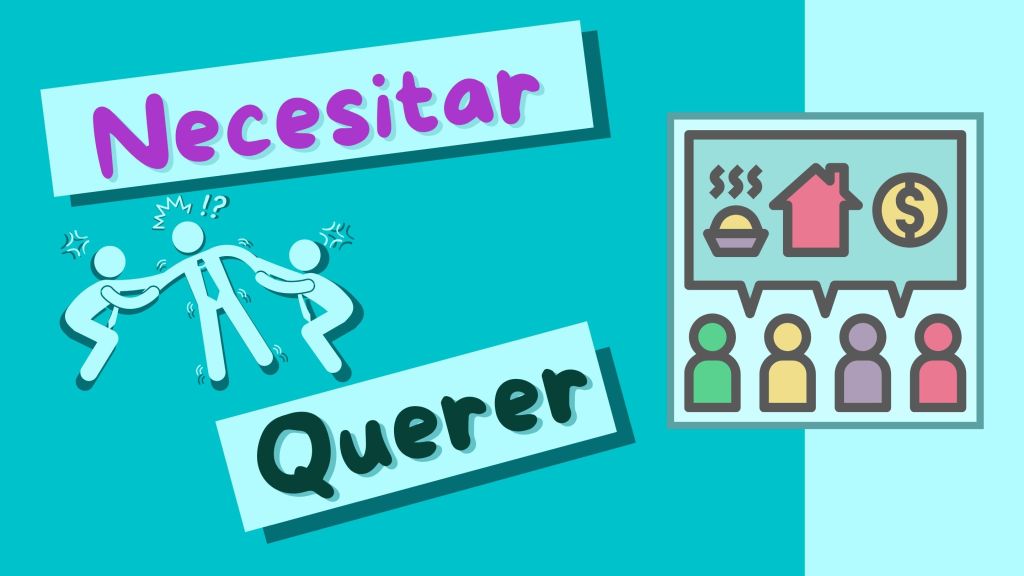
Recently, one thing I need to teach to meet district requirements is the difference between wants and needs and to review the vocabulary associated with that. So, I created a Picture Talk to do just that! This still fits into Cycle 1 Phase 2 of the Stepping Stones framework. You can get it HERE or access it in the resources tab of the blog.
Happy Teaching!
Follow this blog for more great, free resources! Find me on Instagram (@SraKSpanish) and Follow my TpT store as I build more resources!





 Sra. K. Spanish